

Investment Markets Review
U.S. stocks were volatile during the third quarter but managed to post modest gains. The results were noteworthy considering all that investors had to navigate over the past three months, including the July technology stock selloff, the U.S. and Iran’ s Memorandum of Understanding coming undone, a flare-up in the trade relationship between Canada and the U.S., an 83-basis point (where 100-basis points = 1.00%) increase in the 10-year Treasury note, and the first Fed tightening since July 2023. Despite these obstacles, the S&P 500 returned a modest +2.3% during the quarter while the Nasdaq returned +2.6%. The return on the small-cap Russell 2000 Index, which is often more sensitive to interest rates, declined -7.2%, its first quarter of underperformance versus the S&P 500 this year. Most major U.S. indices reached records in August and early September, with the gains concentrated in large technology and A.I. companies. Energy led all sectors as disruptions to the Strait of Hormuz pushed oil up roughly 30%. Interest-rate-sensitive sectors, such as utilities, industrials, and real estate, fell the most due to the rise in interest rates. Very strong earnings growth continues to buttress equity returns, shielding the stock market from rising rates and higher energy costs.
International equity markets were mixed. European stocks slipped, with the MSCI Europe Index declining -1.7%, as investors weighed energy prices, central bank policy, and the Middle East conflict more heavily than investors in the U.S. Outside Japan, most of the rest of Asia equity markets struggled as semiconductor stocks, which makes up a large weight within the Asian stock markets, corrected early in the quarter.
Fixed income had its worst quarter since 2022. Persistent inflation and resilient economic growth pushed the Fed to raise rates for the first time in three years (to 3.75% – 4.00%) and signaled at least one more hike. The 10-year Treasury yield jumped to 83--basis points, and the 30-year yield reached its highest level since 2004. The Bloomberg U.S. Aggregate Bond Index lost about -3.5%. Municipal bonds fared worse; the S&P Intermediate Municipal Bond Index fell -5.0%, pressured by heavier supply of bonds and tax related selling. The upside of the large move in interest rate is higher yields for investors.
Should We Worry About Rising Bond Yields?
The Fed's widely expected decision to raise the Fed Funds Target Rate by 25-basis points, to 3.75% - 4.00%, has the US Treasury market reeling. The yield on the 10-year Treasury bond rose above 5% for the first time in nearly 20 years.
The Fed’s decision was not the only catalyst for higher rates. Indeed, interest rates started rising before the Fed announced its decision. Since November 2025, yields have been up by more than one percentage point.
The most significant contributor to rising rates is higher inflation. Inflation has been running hot globally starting with the COVID-19 pandemic owing to the constraints it placed on manufacturing and supply chains. The next setback came from Russia’s invasion of Ukraine. The conflict disrupted the supply of key commodities, such as oil, natural gas, wheat, and fertilizer. The most recent shock came from the war with Iran, which closed the Strait of Hormuz and reduced the supply of oil and other related refined products (e.g., diesel, gasoline, and heating oil). Although inflation has come down considerably from the highs reached in the summer of 2022, it remains above the Fed’s target of 2.0%, with CPI currently sitting at 3.4%.
The second-most cited explanation for rising interest rates is accelerating fiscal spending, led by the U.S., but stretching to other regions, most notably Europe. The resulting budget deficits have made some investors concerned that financing them will require an increasing supply of debt, which would push bond prices lower and yields higher.
There are a host of other factors that pundits use to support the case for higher yields. The enormous amount of debt being issued to fund the buildout of artificial intelligence infrastructure may be crowding out other borrowers, including the U.S. government, forcing other borrowers to offer higher yields to compete. In addition, there are concerns about the independence of the Federal Reserve, which may reduce the financial system’s confidence in its top central bank. Finally, quantitative tightening (more precisely, the unwind of previous quantitative easing) is removing a large source of demand for Treasuries. Regardless of the reasons, a higher-rate environment appears durable.
That brings us to the title question: should we worry? As with many questions, it depends on your perspective. For this letter’s purposes, we are taking the viewpoint of the bond investor. Of course, rising interest rates influence economic growth, corporate earnings, valuations, discount rates, foreign exchange rates, and other financial and economic variables. We will leave those discussions for a future article.
Bond investors are rightly concerned about rising interest rates. When rates rise, the price of existing bonds fall because bonds that are already issued, which now carry lower yields than newly issued bonds, are less attractive to investors without a reduction in prices. The total return of a bond portfolio includes both the coupon payments and the gain or loss on the price of the bonds owned, so declining prices threaten to eat into the income component of return.
The return on an individual bond is equal to the yield-to-maturity of the bond at the time it is purchased. During the bond’s lifetime, its price will move around with changing interest rates; however, at maturity, the investor receives the bond principal that they are owed. The wildcard, of course, is the possibility the issuer defaults, and, if so, what the recovery value of any collateral would be. For our purposes, we will take most of the default risk off the table by focusing on U.S. Treasury bonds.
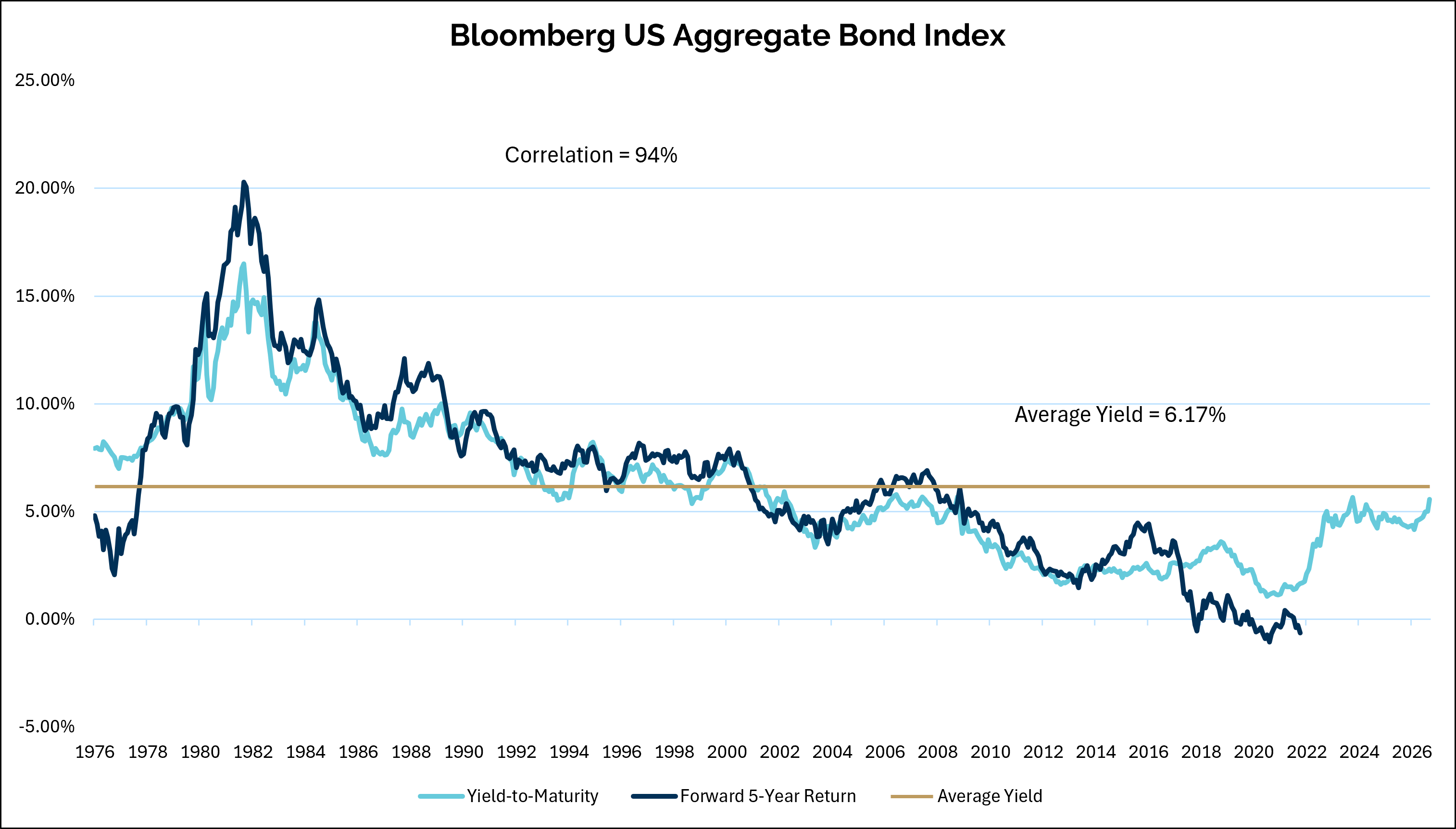
Chart 1
Source: Morningstar Direct and Bloomberg Finance L.P.
Chart 1 above compares the subsequent five-year return of a bond portfolio with its yield-to-maturity at the time of purchase. It shows that yield-to-maturity is also a good predictor of a portfolio’s future return. We can use this to help explain why fixed-income returns were so low over the past five years. During the fall of 2021, the 10-year Treasury bond yielded below 1.5%. Low yields like this leave less of an income buffer to offset price movements caused by changing interest rates.
Over the 20 years leading up to the Great Financial Crisis (GFC), the 10-year Treasury yield averaged just over 6%. With yields now heading back toward their longer-term averages for the first time in a while, fixed-income investors don’t have to take on too much risk to find adequate yields.
There are reasons to believe that the longer-term outlook for inflation may be more benign than is currently expected. Most of the recent reacceleration in inflation is energy related, caused by events like the Iran and Ukraine wars. Most importantly, wage inflation remains low. Labor is the largest cost for most businesses, especially the service-oriented U.S. economy. Accelerating wage growth is almost always evident during inflationary regimes. The fact that we have not seen that yet argues that this bout of inflation may prove to be transitory.
Fixed-income investors may have reasons for optimism. Rates may drift higher over the coming months, with no end in sight for the Iran war. Another rate hike by the Fed this year, which is widely expected, will also put upward pressure on yields. Beyond the near-term headwinds, with yields back near their historic averages, longer-term returns from fixed income may be more competitive than at any point since the GFC.
Midterms
It is about a month from the midterm elections and, thus far, it feels like the investment markets are concentrating on other issues. As we approach election day, that is certain to change.
The prediction markets have the Democrats taking both the House and the Senate, but those can be fickle. Most professional forecasters believe the Democrats will win the House by picking up at least five seats. Expectations for the Senate race are a little more mixed. Republicans can lose a net three seats before losing control.
There is still a long way to go before November 3rd in political terms. A surprise directly or indirectly related to the Russia-Ukraine and U.S.-Iran conflicts is not out of the question. In fact, recently, there were two thwarted terrorist attacks: the flydubai flight heading to Tel Aviv where the copilot reportedly tried to crash a plan and the RAF Fairford incident where men with explosives were found near a UK-based, U.S. army base. Of course, a surprise can be manifested from more familiar factors, such as economic and earnings reports, material moves within the investment markets, geopolitical crisis, and many more.
If history is a guide, the Republicans are likely to lose something this November. Whether that is just seats or control of the Senate or the House is still to be determined. In 18 of the 20 midterms since WWII, the president's party lost House seats. Moreover, most of the time when one party completely controls all three branches, it loses one of two chambers of Congress.
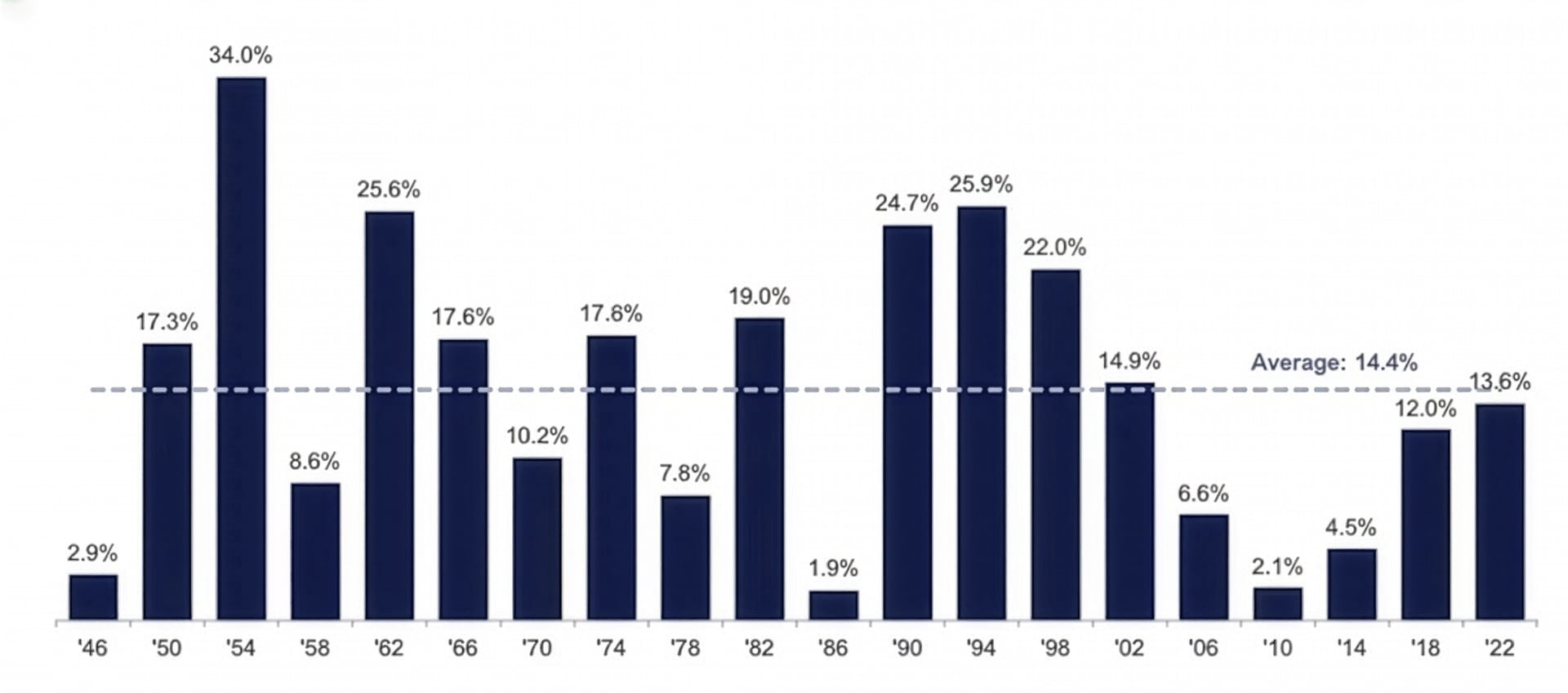
From the markets’ perspective, the U.S. midterm election is another source of uncertainty. If the incumbent party loses seats as normal, it will increase the likelihood of gridlock, which the market generally views positively. The inability of Congress to pass legislation is considered by many to be a feature not a bug as investors prefers the status quo over unexpected law changes. This may be why, since 1946, the S&P 500 has always produced positive returns 12 months after the election (see Chart 2 below). Here’s to 2026/2027 not becoming the exception.
Source: Yahoo! Finance
Conclusion
As we write this, the U.S. stock market is a mere 1.2% below its all-time highs. Nevertheless, we do not sense the level of exuberance usually associated with market tops. Economic and earnings growth continues to exceed expectations by a large margin, which is constructive to equity prices.
That said, there is plenty of uncertainty that is keeping investor enthusiasm in check. We have already discussed the wars in Iran and Ukraine and their effect on energy prices and inflation. These uncertainties keep marginal buyers of equities out of the market, who often capitulate and become buyers as the market marches higher.
The bond market is certainly fighting negative sentiment. The rapid increase in interest rates over the past couple of months has investors anxious. While we expect continued volatility over the near term, we see the glass as half full over the longer term and are looking closely for opportunities to add yield.
For our latest perspectives on markets and economic conditions, view our pintable Q4 2026 analysis.
Sources: Morningstar Direct, Federal Reserve Bank of St. Louis, Yahoo! Finance, and Baird Strategas LLC
Past performance is no guarantee of future results. Investing involves risk, including the possible loss of principal. Historical returns are not indicative of future performance Securities offered through DAI Securities, LLC, Member FINRA/SIPC. Advisory Services offered through Prosperity – An EisnerAmper Company. Prosperity – An EisnerAmper Company is not affiliated with DAI Securities, LLC.