

SpaceX’s initial public offering marked a defining moment in public market history. After growing from a valuation of roughly $12 billion in 2015 to more than $2 trillion1 at listing, the company entered the public markets at a scale with few historical parallels. Having committed to giving access to retail investors, Elon Musk set aside 30% of shares, far above the 5% to 10% typical of large IPOs. However, participation was so strong that 30% was closer to 20%. This cut along with high participation resulted in very small positions for retail investors.
Investors missing out on participating in the IPO will have a second chance through owning passive index funds/ETFs. SpaceX will be absorbed into major equity indexes in stages. The company entered the Nasdaq Composite automatically on day one and will be added to the Nasdaq-100 around July 1, where it will carry an estimated weight of approximately 1.3%. It will enter the Russell 1000 and Russell 1000 Growth on the June 26th reconstitution, with weights of roughly 0.6% and 0.9% respectively. The one major holdout is the S&P 500, which requires four consecutive quarters of GAAP profitability. Given SpaceX's ongoing GAAP losses, inclusion is unlikely before mid-2027 at the earliest and that event, when it comes, represents the single largest increase in passive demand, with an estimated $50 billion or more in forced buying across S&P-linked assets.
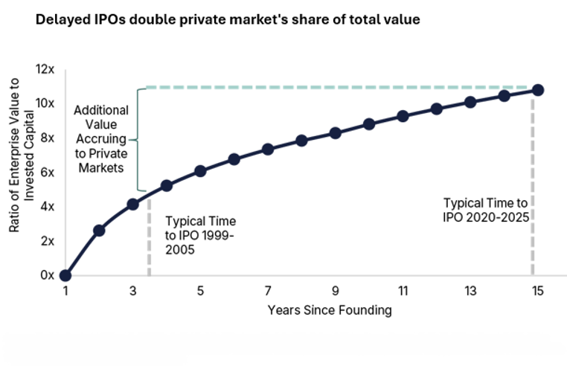
Source: Carlyle Analysis; Ritter, J., (2026), “Initial Public Offerings: Updated Statistics.” Bloomberg, Brown, Keith C., Wiles, Kenneth W., “The Growing Blessing of Unicorns: The Changing Nature of the Market for Privately Funded Companies,” Journal of Applied Corporate Finance, 2020. There is no guarantee any trends will continue.
The Impact of Private Markets
While SpaceX is exceptional in scale and mission, its route to the public markets reflects a broader structural shift. Companies are staying private longer, accumulating more value before listing, and entering public markets at sizes once associated with long-established public companies. Over the past 15 to 20 years, the time to listing has nearly tripled as deeper private capital markets and changing disclosure incentives have reshaped the IPO landscape.2
For companies like SpaceX, the appeal of private capital is not simply avoiding quarterly reporting; it is protecting sensitive information. Businesses built on intangible assets, proprietary technology, production methods, algorithms, and know-how, are reluctant to reveal details that could help competitors replicate their advantage. Going public therefore creates a difficult trade-off: disclose enough to earn investor confidence and risk competitive leakage or disclose too little and leave the business difficult to value.
Private markets ease that tension. Through nondisclosure agreements, investors can access the information needed to underwrite the business without forcing sensitive details into the public domain. As private capital has expanded, companies can delay going public until they reach a scale or market position where disclosure poses less risk to their competitive edge.
The consequences are visible across public equities. Since 2000, the number of U.S. public companies has fallen by half, even as the pool of potential IPO-scale firms has grown 2.6x. Yet the share of companies choosing to go public has dropped 62%.2 As a result, private investors now capture roughly twice the lifetime returns of businesses that eventually go public—returns that historically accrued to the small- and mid-cap segments of the equity market.
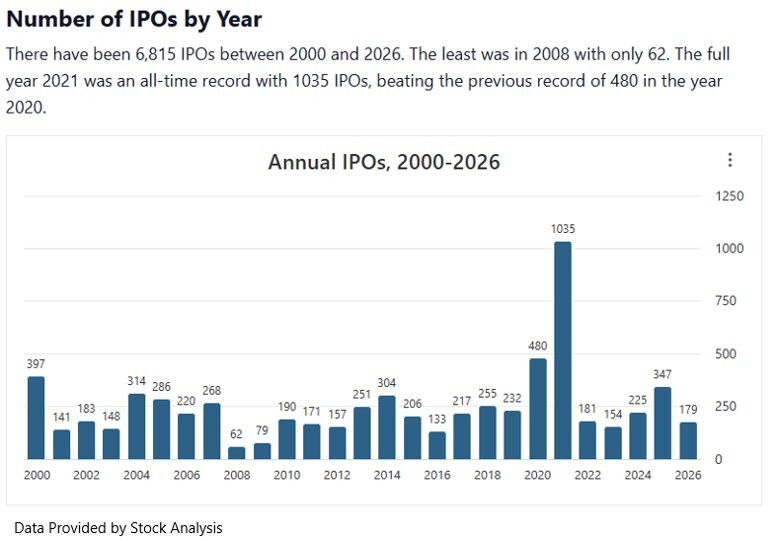
At the same time, IPO activity has become more uneven. The market has always been cyclical, but the last five years have been extreme even by historical standards. After the record-breaking boom of 2020–2021, when more than 1,000 US IPOs came to market in a single year, issuance collapsed in 2022 and 2023 as interest rates rose and valuations reset. Global IPO proceeds fell to their lowest level in a decade.
In an earlier era, a company like SpaceX might have entered the market as a mid-cap growth stock. Today, businesses of similar quality often remain private for far longer because they no longer need a listing to access growth capital or provide liquidity. Instead, new private investors can replace earlier backers and fund the next stage of development.
Weakening Small Cap
The small-cap benchmark Russell 2000 Index has weakened over the past two decades as unprofitable companies have become a larger share of the index, reaching 39% as of June 30, 2024.3 This reflects the broader stay-private trend. With IPO issuance down sharply over the five- and ten-year periods ending in 2023,4 fewer high-quality small companies are entering public markets. As a result, small-cap indexes have become riskier and less compelling. The impact is clear: small caps have lagged large caps by 6.2% annualized over the past decade despite higher volatility, reversing the traditional expectation that investors should earn a premium for taking small-cap risk. This is the primary reason we do not have small-cap exposure in most of our portfolio allocations.
The Potential Upcoming IPO Wave
The IPO market appears to be reopening gradually and selectively. Activity has recovered from the 2022 lows as equity markets stabilize and interest rate volatility declines. A large backlog of mature private companies is preparing to list as conditions improve, but this cycle does not resemble the exuberance of 2021. Investors are instead favoring higher-quality issuers with stronger fundamentals, scale, profitability, and durability.
The next wave of high-profile IPO candidates reinforces the point. Companies such as OpenAI, Anthropic, Databricks, Stripe, Canva, Revolut, and Discord are frequently cited as potential listings, many with large private valuations and business models tied to artificial intelligence, software, fintech, or digital infrastructure. If they come public, they are likely to do so as mature, scaled enterprises rather than emerging growth stories.
¹ “SpaceX Update”, Ladenburg, Market Analysis, June 2026
² “Space commonality”, The Carlyle Compass, Jason Thomas, Head of Global Research & Investment Strategy, Carlyle, June 16, 2026
3 “3 Ways Private Companies Are Reshaping Public Markets”, Zachary Evens, Morningstar September 24, 2025
4 “Refining Small Caps, Active management can act as quality control for small-cap investors.”, Aristotle Funds, December 2024